
My husband said he wanted yellowtail sashimi, or bangeo-hoe (방어회) as we say in Korea, where sashimi is called hoe (회). Japan is known for aged sashimi, but in Korea most hoe is hwaleo-hoe (활어회), sliced from fish that were swimming in a tank minutes before. So on a rainy Saturday evening in mid-November we hopped on the subway to Noryangjin Fish Market. We spent about 15 minutes inside, walked out with a box of sliced fish, and were eating at our own table before 7 p.m., a cold 1664 Blanc next to the plate.
That’s the quick version. The classic way to do Noryangjin is different: you buy fish on the first floor, then carry it upstairs and eat it at a restaurant. That two-floor system is the thing first-timers get confused about, so I’ll walk through both ways below.
Quick background: Noryangjin is Seoul’s biggest seafood market, a wholesale fish market in South Korea’s capital that also sells to regular shoppers. Yellowtail is the winter favorite, in season roughly November to February. Korea has four distinct seasons, and every season has its own fish that tastes best at that time, so there’s always some hoe in season. The famous early-morning auction is only for licensed wholesalers, so as a visitor you’ll be shopping at the retail stalls.
📍 674 Nodeul-ro, Dongjak-gu, Seoul
Korean address for taxis and map apps: 서울특별시 동작구 노들로 674
🕚 Retail stalls open year-round; hours vary by stall (general stalls roughly 1:30 a.m.–10 p.m.)
🎟️ Free to enter
🚇 Subway Line 1 or Line 9, Noryangjin Station (we used Exit 9)
🅿️ Paid parking on the 3rd and 4th floors of the market building (about 1,150 spaces; free 4–8 a.m.). Ask the stall you buy from for a parking discount ticket
📞 02-2254-8000
ⓘ Info checked in November 2026. Hours and prices may change, so check before you go.
Our Visit at a Glance
- When: Saturday evening around 6 p.m., mid-November, raining
- Who: me and my husband
- Time inside: about 15 minutes
- Getting there: subway, since we live near Seoul Station
- Crowds: busy. Yellowtail season seemed to bring out everyone in Seoul
- What we did: bought sashimi to go and ate at home

How Noryangjin Fish Market Works: Buy Downstairs, Eat Upstairs
The first floor is where you shop. The tanks and counters are split into sections, and each section sells different things, so live fish, chilled fish, frozen seafood and shellfish aren’t all mixed together. You pick your fish, and the vendor slices it into hoe right there.
Then you have a choice. You can take it home packed to go, the way we did. Or you can take it up to the second floor, where restaurants will seat you and serve the fish you bought downstairs. Some stall staff walk you up, or you can go yourself and tell the restaurant what you bought. Most of the restaurants are on the second floor, and there are more on the fifth.
The restaurant doesn’t charge you for the fish. Instead they charge a sangcharim-bi (상차림비, a per-person table setting charge) that covers sauces, lettuce, side dishes and your seat. It varies by restaurant, so ask before you sit down. Shellfish and crab can be steamed or grilled for an extra cooking fee, and you can order maeuntang (매운탕, spicy fish stew made from the leftover head and bones). The second floor also sells its own food, like fried dishes.

We skipped the table charge and ate at home. While we were at the stall, a regular came in with a daughter, three people in all, and asked the owner to set up a table upstairs. The second floor was completely full, but a regular is a regular, so the owner made it work anyway.

Buying Yellowtail at Gohung Susan (고흥수산)
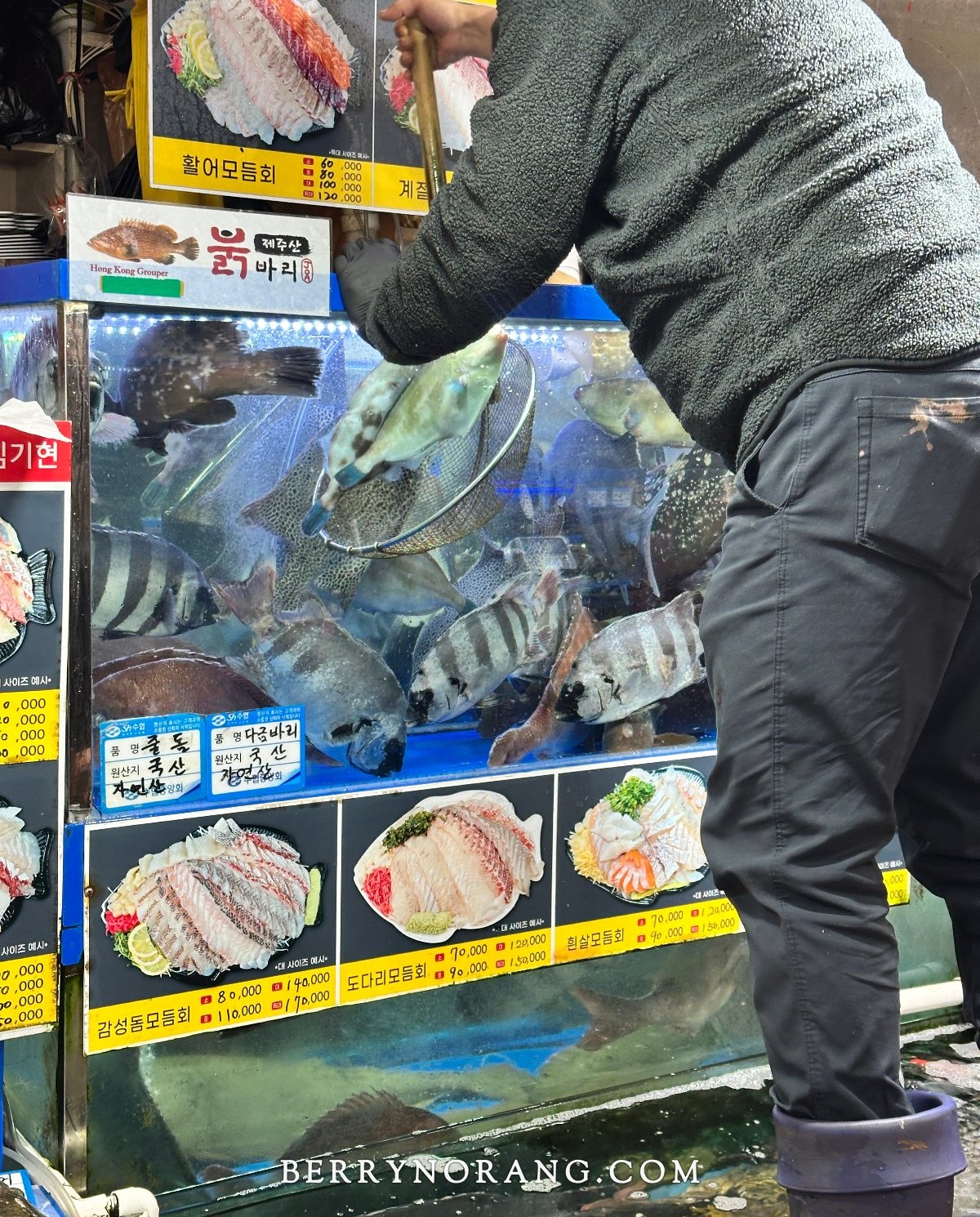
My husband picked Gohung Susan without much thought. It was our first time there. The owner spoke really good Chinese, and while we were waiting, a Chinese customer bought a single Jeju bulgbari (붉바리, red spotted grouper) for ₩210,000. One fish!

Prices were written on the menu board like fixed prices, so we didn’t haggle. I asked for seobiseu (서비스, a free extra) instead, and since I love salmon, we got salmon on the house. We paid by card. Some shops had ordering kiosks, and those seemed to be full of younger shoppers. I just went with the place that took my card.
We paid ₩70,000 for a small sashimi platter that included slices from an extra-large yellowtail. Yellowtail really is pricey. The prices looked about the same from shop to shop, and this year wholesale yellowtail prices at Noryangjin in early November were well above last year’s.
| Gohung Susan menu | Small | Medium | Large | Extra large |
|---|---|---|---|---|
| Yellowtail sashimi / yellowtail assorted platter, from an extra-large yellowtail (특대 방어회·방어모듬회) | ₩70,000 | ₩100,000 | ₩130,000 | ₩160,000 |
| Striped jack assorted platter (줄무늬 전갱 모듬회) | ₩80,000 | ₩110,000 | ₩140,000 | ₩170,000 |
| Live fish assorted platter (활어모듬회) | ₩60,000 | ₩80,000 | ₩100,000 | ₩120,000 |
| Seasonal assorted platter (계절모듬회) | ₩70,000 | ₩100,000 | ₩130,000 | ₩160,000 |

The yellowtail and the flounder (gwangeo, 광어) were both cut from big, wild-caught fish and sold in portions. We watched them slicing.

A little history: the market started in 1927 as Gyeongseong Susan on Uiju-ro, near Seoul Station, and moved to Noryangjin in 1971. The modern building you’ll walk into opened in 2016, and the old market building was torn down in 2020.
What We Ate at Home
We went home with yellowtail, flounder and the bonus salmon, and laid it out with a 1664 Blanc, chojang (초장, a sweet, tangy chili sauce made with gochujang and vinegar), and soy sauce with wasabi. In Korea, people dip hoe in ssamjang (쌈장, a thick soybean and chili paste), chojang, or soy sauce with wasabi, and for me, chojang is the real deal. Most Koreans drink soju with hoe, but I had mine with that Blanc. Both go great with it. It’s yellowtail season, so the yellowtail was delicious.

In Korea, most places sell small farmed flounder. Big wild ones aren’t impossible to find, but you don’t see them often. Here they were cutting portions off a big wild one, and it really did taste better than the small farmed kind.
One downside: since our fish came as portions from a big fish, there was no head or bones for maeuntang. No stew for us this time, and that hurt, because I love maeuntang. It’s so good, and with sujebi (수제비, hand-torn dough) dropped in, it’s the best.

One thing to know: Noryangjin sells hwaleo-hoe, not sukseong-hoe (숙성회, aged raw fish). For aged fish, you need to go to a separate aged-sashimi restaurant. To me the two taste different, so try both if you get the chance.
Things I Wish I Knew Before Visiting Noryangjin Fish Market
- Look for a stall with clearly posted prices, then ask for service. That works better than haggling over the number.
- Want maeuntang? Ask before you buy. Fish cut from a bigger fish may not come with the head and bones.
- Touts are a thing. Vendors will try to steer you to their shop, so be ready to smile and keep walking.
- Decide where you’ll eat before you buy. Upstairs means a table charge per person. Takeout means none.
- Wear shoes that can handle wet floors, especially on a rainy day like ours.
- Use Naver Map or Kakao Map to get there. Google Maps doesn’t give good walking or transit directions in Korea.
Noryangjin Fish Market: Our Verdict
If you want to see what a real local fish market in Korea feels like, Noryangjin is the place. If you don’t eat raw fish often, picking your fish and watching it get sliced is a fun thing to try at least once. If you live near Noryangjin, it’s an easy run for dinner, and it’s great for getting together with friends.
For us it was a quick in-and-out trip for yellowtail on a rainy night.
Berry’s verdict: Go if you want a taste of a real local fish market, and bring friends. Every season has its own fish. ★★★☆☆
Norang’s verdict: Sounds like a paradise for cats. But there’s not a single cat there. A sad place. ★☆☆☆☆
More Photos


FAQ
Is Noryangjin Fish Market worth visiting?
If you want a local fish market experience, yes. We gave it three stars. Every season has its own fish, and it’s even better with friends.
How do I get to Noryangjin Fish Market from Seoul Station?
Take subway Line 1 from Seoul Station to Noryangjin Station. We live near Seoul Station and took the subway both ways.
Can I pay by card at Noryangjin Fish Market?
We paid by card at Gohung Susan, and many stalls take cards. Some are more cash-oriented, so ask before they start slicing.
🇰🇷 한국어로 읽기
서울 노량진수산시장 방어회 후기|1층 구매·2층 상차림·메뉴 가격
노량진수산시장 방어회 포장 후기
남편이 방어회를 먹고 싶다고 해서 비 오는 토요일 저녁, 노량진수산시장에 다녀왔어요. 방어철이잖아요 ㅎㅎ 시장 안에는 15분쯤 있었고, 포장해서 집에 와 7시 전에 1664 블랑이랑 먹었습니다.
저희 집이 서울역 근처라 노량진이 가까워요. 서울역에서 지하철 1호선을 타면 되고, 저희는 노량진역 9번 출구로 나갔어요.
📍 서울특별시 동작구 노들로 674
🕚 연중무휴 (점포별로 다르고, 일반 점포는 대략 01:30~22:00)
🎟️ 입장료 없음
🚇 지하철 1호선·9호선 노량진역
🅿️ 건물 3·4층 유료 주차장 (약 1,150대, 오전 4~8시 무료). 산 가게에서 주차할인권을 받을 수 있어요
📞 02-2254-8000
ⓘ 2026년 11월 기준 정보예요. 방문 전에 한 번 더 확인해 주세요.
1층에서 사고 2층에서 먹는 노량진수산시장 이용법
1층이 수산물을 파는 곳이에요. 구역별로 파는 것이 달라서 활어, 선어, 냉동, 조개류가 나뉘어 있어요. 생선을 고르면 그 자리에서 회를 떠 줍니다.
그다음은 두 가지예요. 저희처럼 포장해서 집에 가도 되고, 회를 들고 2층 식당으로 올라가서 먹어도 돼요. 매장 직원이 데려다 주기도 하고, 직접 올라가서 1층에서 뭘 샀는지 말해도 됩니다. 식당은 2층에 제일 많고, 5층에도 있어요.
2층 식당은 회 값 대신 상차림비를 받아요. 초장, 채소, 기본 반찬, 자릿값이고 식당마다 달라서 앉기 전에 물어보면 좋아요. 조개나 게는 찜이나 구이로 해 주는데 조리비가 따로 붙고, 남은 머리와 뼈로 매운탕도 주문할 수 있어요. 2층에서 튀김 같은 것도 팔더라고요.
저희는 상차림비가 있어서 그냥 집에서 먹었어요. 가게에 있는 동안 단골손님이 오셨는데, 딸이랑 셋이 왔다고 2층에 자리를 만들어 달라고 하시더라고요. 2층이 꽉 찼는데도 역시 단골이라 사장님이 자리를 만들어 주셨어요 ㅎㅎ
고흥수산 메뉴와 가격
남편이 쓱 고른 가게가 고흥수산이에요. 저희는 처음 가 봤어요. 사장님이 중국어를 잘하셨어요 ㅋㅋ 기다리는 동안 중국인 손님이 제주도 붉바리를 한 마리에 21만 원 주고 사 가더라고요 ㄷㄷ
가격이 정가처럼 쓰여 있어서 흥정은 안 했어요. 대신 서비스를 달라고 했고, 제가 연어를 좋아해서 연어를 서비스로 받았습니다 ㅋㅋ 계산은 카드로 했어요. 키오스크를 쓸 수 있는 매장도 있었는데 거기는 젊은 사람이 많더라고요. 저는 그냥 카드 되는 곳으로 갔어요.
저희가 산 건 특대 방어모듬회 소, 7만 원이에요. 역시 방어는 비싸요. 가게마다 가격은 다들 비슷했어요. 올해는 11월 초 노량진 방어 경락 시세도 작년보다 많이 올랐다고 하네요.
| 고흥수산 메뉴 | 소 | 중 | 대 | 특대 |
|---|---|---|---|---|
| 특대 방어회·특대 방어모듬회 | 70,000원 | 100,000원 | 130,000원 | 160,000원 |
| 줄무늬 전갱 모듬회 | 80,000원 | 110,000원 | 140,000원 | 170,000원 |
| 활어모듬회 | 60,000원 | 80,000원 | 100,000원 | 120,000원 |
| 계절모듬회 | 70,000원 | 100,000원 | 130,000원 | 160,000원 |
광어와 방어는 자연산 큰 것(대자)에서 소분해서 팔았어요. 손질하는 걸 옆에서 구경했습니다.
짧은 역사: 노량진수산시장은 1927년 서울역 근처 의주로에서 ‘경성수산’으로 시작해서 1971년에 지금 자리로 옮겼어요. 지금 건물은 2016년에 문을 열었고, 옛 건물은 2020년에 철거됐습니다.
집에서 먹은 방어회와 자연산 대광어
방어회, 광어회, 서비스 연어를 집에 펼쳐 놓고 1664 블랑, 초장, 간장+와사비랑 먹었어요. 한국에서는 회를 쌈장, 초고추장, 간장(+와사비)에 찍어 먹는데, 저는 초고추장이 근본이라고 생각해요 ㅋㅋ 보통 회는 소주랑 먹는데, 저는 블랑이랑 먹었어요 ㅋㅋ 둘 다 잘 어울려요. 방어철이라 맛있었습니다 😋
한국에서는 보통 작은 양식 광어를 팔잖아요. 자연산 대광어는 아예 안 파는 건 아니지만 잘 안 팔아요. 여기는 자연산 대광어를 소분해서 팔아서 맛있었어요. 양식 작은 광어보다 큰 게 맛있긴 하더라고요 👍
아쉬운 점은 큰 생선에서 소분한 거라 매운탕거리가 안 나왔어요. 그래서 매운탕은 못 먹었습니다 ㅠㅠ 매운탕 진짜 좋아하는데… 매운탕 아주 맛있거든요. 수제비 넣어 먹으면 맛도리인 것을!
참고로 노량진에서는 수조에서 바로 잡아 뜨는 활어회를 팔고, 숙성회는 안 팔아요. 숙성회는 숙성회집에 따로 가야 해요. 일본은 숙성회가 많고, 한국은 활어회가 많아요. 개인적으로 숙성회랑 활어회는 맛이 달라서 둘 다 맛보면 좋아요.
가기 전에 알았으면 좋았을 것
- 정찰제로 가격이 잘 쓰여 있는 가게를 찾아서, 흥정 대신 서비스를 달라고 하는 게 좋아요.
- 매운탕을 먹고 싶으면 사기 전에 매운탕거리가 나오는지 물어보세요. 소분해서 파는 곳은 안 나올 수 있어요.
- 호객행위가 은근히 있어서 잘 피해야 해요.
- 어디서 먹을지 미리 정하고 사세요. 2층은 인당 상차림비가 있고, 포장은 없어요.
- 비 오는 날은 바닥이 젖어 있으니 미끄럽지 않은 신발이 좋아요.
노량진수산시장 총평
로컬 수산시장을 느끼고 싶으면 추천해요. 평소에 회를 자주 안 먹는 분이라면, 직접 생선을 고르고 회 뜨는 걸 보는 것만으로도 체험해 볼 만해요. 노량진 근처에 살면 가기 좋고, 친구들이랑 친목 다지기에도 좋아요 ㅎㅎ
저희는 비 오는 밤에 방어 사러 후다닥 다녀온 짧은 나들이였어요.
베리의 한 줄 평: 로컬 수산시장을 느끼고 싶으면 친구들이랑 가 보세요. 한국은 사계절이라 철마다 맛있는 생선이 있어요 ★★★☆☆
노랑이의 한 줄 평: 고양이들의 파라다이스처럼 들리는 곳. 하지만 고양이는 한 마리도 없다냥. 슬픈 곳이다냥 ★☆☆☆☆
⭐ 별점 기준 보기
Leave a Reply